Chromium
Creates ruby’s red. It can also make a ruby fluoresce—adding a vivid inner glow in sunlight or ultraviolet light.

THE MINERAL BEHIND RUBY & SAPPHIRE
Ruby and sapphire seem like separate legends. Beneath the names, both are corundum: aluminum and oxygen arranged into one of nature’s most durable crystalline structures.
Begin with the mineral ↓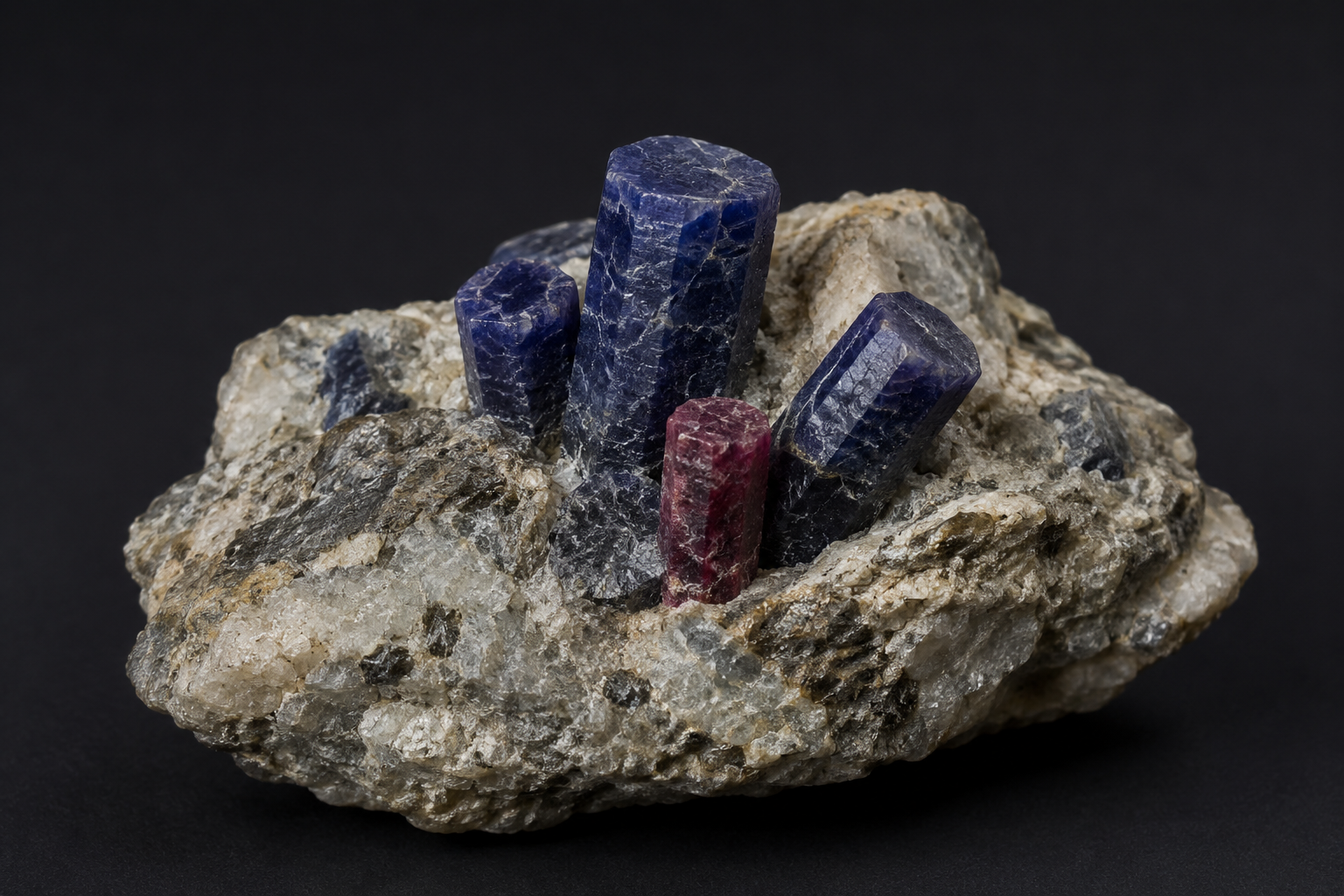
THE IDENTITY CARD / 01
Corundum is crystalline aluminum oxide. Its structure is compact, stable and unusually resistant to wear—properties that make it both a treasured gem mineral and a serious industrial material.
 THE CORUNDUM COLOR FAMILY · EDUCATIONAL ARTWORK
A HANDFUL OF ATOMS / 02
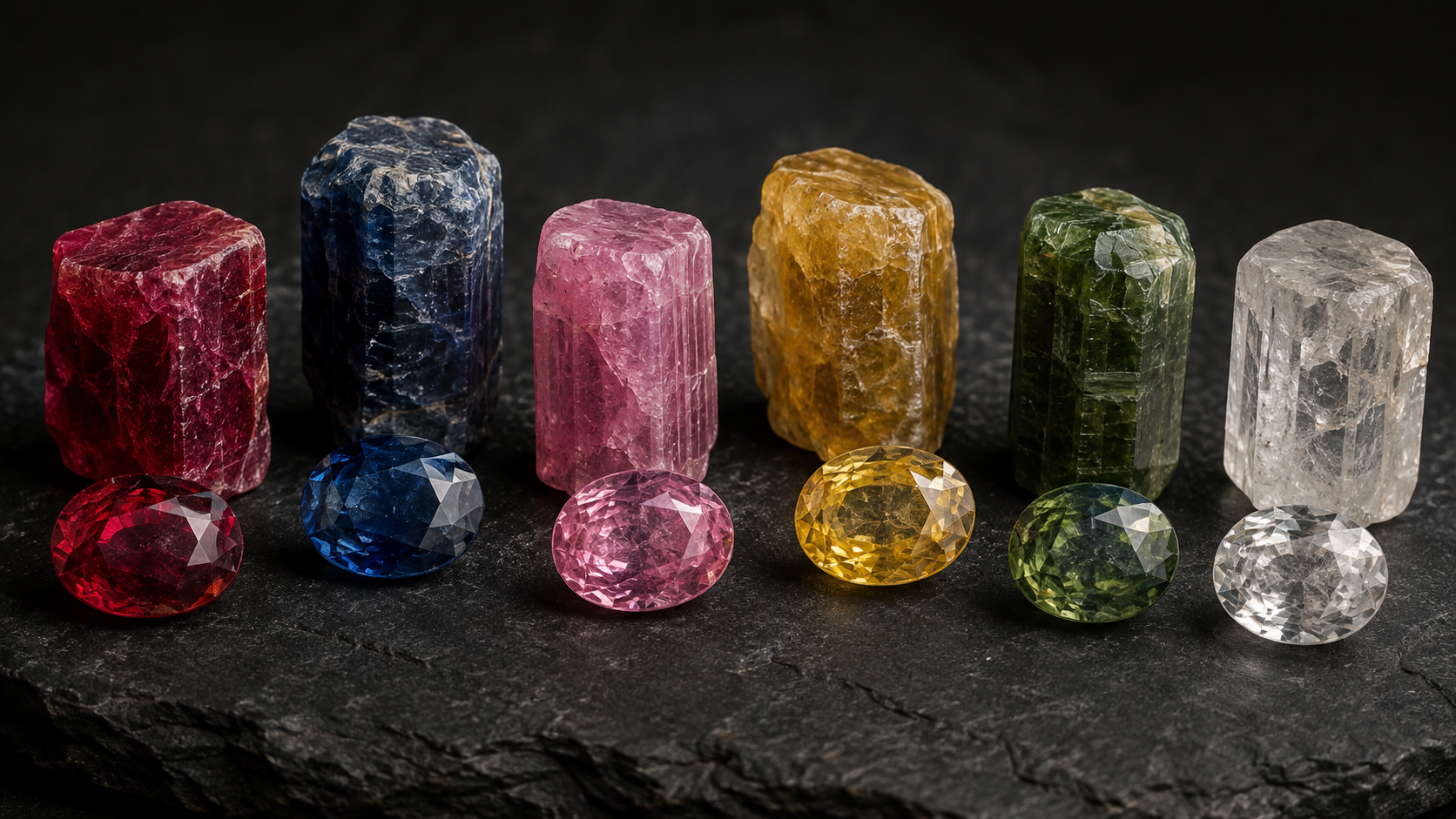
A trace element may represent only a tiny fraction of a crystal, yet it can decide whether corundum becomes ruby red, sapphire blue, golden yellow, green, violet—or nearly colorless. Color zoning records how those elements varied while the crystal grew.
Creates ruby’s red. It can also make a ruby fluoresce—adding a vivid inner glow in sunlight or ultraviolet light.
Their interaction is responsible for much of blue sapphire’s color. Slight chemical shifts can move the appearance from inky blue to teal.
Often contributes yellow and green. The exact color depends on its charge state, concentration and neighboring trace elements.
Can contribute violet or color-change behavior in some sapphires, especially when the lighting spectrum changes.
THE LESSER-KNOWN / 03
Chemically pure corundum is colorless. Nearly every celebrated color comes from tiny amounts of other elements entering the crystal lattice.
Fine, aligned rutile needles—called silk—can reflect light as a six-rayed star. The Star of India’s famous asterism exists because of this internal structure.
They are not merely related stones. They are the same mineral species. Red gem corundum is ruby; gem corundum in the other colors is sapphire.
Corundum is pleochroic. Viewed in different crystal directions, a single stone may reveal different colors or intensities.
At 9 on the Mohs scale, corundum resists scratching extraordinarily well. A sharp impact can still chip a girdle or facet edge, so hardness is not the same as toughness.
Corundum can survive erosion that destroys softer host rock. That durability is why many sapphires and rubies are recovered from river gravels far from where they first formed.
BEAUTY IN IMPERFECTION / 04
When microscopic rutile needles grow in three intersecting directions, a domed cabochon can gather their reflections into a moving six-rayed star. The effect is called asterism. The cut does not add the star—it positions the crystal so the hidden geometry becomes visible.
The American Museum of Natural History’s Star of India weighs just over 563 carats, carries a star on both sides and is estimated to be about two billion years old.
A SHORT HISTORY / 05
For most of history, gems were named by appearance. Ruby, sapphire and red spinel crossed empires before anyone knew their formulas. Mineralogy eventually separated look-alikes; modern gemology added origin, treatment and growth history to the story.
Ruby was revered across Asia long before mineral chemistry existed. In Sanskrit it became ratnaraj—“king of gems.” Red spinel was also mistaken for ruby for centuries, including in royal collections.
Myanmar’s Mogok Stone Tract became legendary for ruby. Sri Lanka’s gem gravels built an equally deep sapphire tradition, with stones traded far beyond the island.
The 135.74 ct Grand Sapphire entered the French crown jewels during the reign of Louis XIV. It survived revolution, disappearance and recovery, and has been held by France’s natural-history museum since 1796.
Crystal measurement helped mineralogists separate corundum from look-alikes such as spinel. Old ‘rubies’ could finally be tested as minerals rather than judged by color alone.
Auguste Verneuil announced flame fusion, the first practical process for growing synthetic ruby. Laboratory corundum was chemically corundum—but its origin and growth record were entirely different.
Natural ruby and sapphire remain treasured gems, while synthetic corundum works quietly in watch crystals, optical windows, electronics and abrasives. The same structure serves both beauty and industry.
BEYOND THE JEWEL BOX / 06
Corundum’s hardness made it an abrasive long before “sapphire glass” entered modern vocabulary. Today, synthetic corundum appears in scratch-resistant watch faces, optical windows, scientific instruments and electronic substrates.
That industrial reach is part of the wonder: the atomic architecture that holds a polished facet also survives demanding technical work. Natural and laboratory-grown corundum share the same essential chemistry, while telling fundamentally different stories of origin.
Why The House of Corundum chooses naturalSOURCES & FURTHER READING